Plan your project before it plans you.
Whether you're renovating a kitchen in Hancock Park, adding a second story in Brentwood, building an ADU in Mar Vista, or taking on a full home remodel anywhere in Los Angeles — the decisions made before construction begins determine how well the project goes.
Six stages every Los Angeles project goes through
Most renovation problems aren't construction problems — they're planning problems. Getting these six stages right, in sequence, is what separates projects that go smoothly from ones that don't.
Defining the scope
The foundation everything else rests on. Without a precise scope, budgets drift, timelines slip, and decisions get made in the field that should have been made at the table.
Researching costs
A budget built on guesswork is not a budget — it's a wish. Real cost research gives you a number you can actually plan around before any commitments are made.
Permits and compliance
In Los Angeles, unpermitted work affects your ability to sell, refinance, or insure the property. Getting this right from the start is not optional.
Architects and engineers
Not optional extras on complex projects — they are the people who make the project possible, legal, and safe. Understanding what each one does helps you involve them at the right time.
Financing the project
How you fund the project affects the project itself — the timeline, the decisions you can make, and the pressure you're under during construction.
Contractor selection
Who builds the project and how the construction process is coordinated matters more than most homeowners anticipate. Both decisions shape the outcome from the first day on site.
Define exactly what you're building — and what you're not
A well-defined scope is the foundation everything else rests on. Without it, budgets drift, timelines slip, and decisions get made in the field that should have been made at the table.

Objectives, phasing, and deliverables
Start by defining what the project is meant to accomplish — not just what it will include, but why. A kitchen remodel that's really about how your family moves through the home is a different project than one that's about resale value, even if the scope looks identical on paper.
Break the project into phases that can be planned, scheduled, and resourced independently. Identify the specific deliverables at each milestone. The more precisely you can describe what done looks like at every stage, the fewer surprises you'll encounter along the way.
Define what's excluded just as clearly as what's included. Scope creep is one of the most common reasons Los Angeles renovation projects run over time and over budget. A clear scope document gives everyone involved a single point of reference.
Define the purpose
Before listing what you want built, articulate why. The purpose of the project — livability, resale, aging in place, adding rental income — shapes every decision that follows, from design to materials to budget allocation.
Break it into phases
Even a single-phase project benefits from being mapped in stages. Identify what needs to happen first structurally, what depends on other work being complete, and where the natural decision points are before work begins.
Document what's excluded
Write down what the project does not include. Explicit exclusions prevent misunderstandings between homeowners, architects, and contractors — and give you a clear framework for evaluating change orders if and when they come.
Complexity, risk, and resource planning
A well-defined scope makes accurate cost estimation possible by clarifying which materials, equipment, trades, and coordination will be required. It also surfaces risks early — before they become expensive field decisions — and makes it possible to plan contingencies before you need them.
For complex projects, the scope document also clarifies roles. Who is responsible for what, and at which stage? Where does the architect's responsibility end and the contractor's begin? Establishing this in writing at the outset prevents the gaps and overlaps that slow projects down and create disputes later.
Research material and labor costs before you set a budget
A budget built on guesswork is not a budget — it's a wish. Real cost research takes time, but it gives you a number you can actually plan around.
Quotes, labor rates, and market reality
Get quotes from multiple suppliers for your primary materials — concrete, framing lumber, roofing, plumbing fixtures, electrical supplies, finishes. Prices vary significantly across suppliers, and understanding the range helps you identify where quality and cost trade off against each other.
Research current labor rates in Los Angeles for each trade your project will require. Labor costs in Southern California are among the highest in the country, and they vary further by trade, project complexity, and contractor tier. Don't rely on national averages or online calculators — talk to contractors directly and cross-reference with industry sources.
Build in a contingency from the beginning. For renovation projects, 10–15% is standard. For projects involving older homes, structural unknowns, or significant site constraints, 20% is more realistic. A contingency is not a sign that the budget is sloppy — it's a sign that it's honest.

What drives cost in Los Angeles
Labor rates, site access constraints, permit fees, soil conditions, and seismic requirements all affect construction costs in ways that national estimates don't capture. Hillside lots in Silver Lake or Pacific Palisades, for example, carry meaningfully different cost profiles than flat lots in Sherman Oaks or Encino.
Where budgets typically break down
Most budget overruns aren't caused by one large event — they're caused by the accumulation of small decisions made without a clear framework. Material upgrades, scope additions, and unforeseen conditions each add a manageable amount; together, they compound. A realistic contingency and a disciplined scope document are the best defenses against both.
Permits, licenses, and compliance in Los Angeles
In Los Angeles, unpermitted work doesn't just create legal risk — it affects your ability to sell, refinance, or insure the property. Getting permits right from the start is not optional.
What requires a permit in Los Angeles
Most structural work, electrical upgrades, plumbing changes, HVAC modifications, and additions require permits through LADBS — the Los Angeles Department of Building and Safety. This includes ADUs, room additions, garage conversions, and most kitchen and bathroom remodels that involve moving walls or changing systems.
Work that is purely cosmetic — painting, flooring, cabinet replacement without moving plumbing — typically does not. If you're unsure, the safest approach is to ask before starting. Unpermitted work discovered during a sale or appraisal creates complications that are expensive and time-consuming to resolve.
Understanding the permit process
The permit process in Los Angeles begins with submitting plans to LADBS for review. Depending on the project, this may involve over-the-counter approval for straightforward work or a plan check process that can take weeks to months for larger projects. Your architect or contractor should be able to guide you through what to expect for your specific scope.
Permit fees vary based on project valuation and type — factor them into your budget early. Plan check corrections are common; budget time for a response cycle before you can expect approval.
Licenses and insurance — what to verify before anyone starts work
Every contractor working on your home in California must hold a valid license issued by the Contractors State License Board (CSLB). Verify the license number before signing any contract. Check that it is active, covers the type of work being performed, and is not subject to any disciplinary actions.
General liability insurance and workers' compensation coverage are non-negotiable. Ask for certificates of insurance before work begins and confirm the coverage limits are appropriate for the scale of your project. If a worker is injured on your property and the contractor carries no workers' comp, the liability can fall to you as the homeowner.
When to involve an architect, and what an engineer actually does
Architects and engineers are not optional extras on complex projects — they are the people who make the project possible, legal, and safe. Understanding what each one does helps you involve them at the right time.
What an architect brings to your project
An architect's primary job is to translate what you want to live in into a set of documents that can be permitted, priced, and built. That sounds straightforward, but it requires a deep understanding of how space actually works — how light moves, how people move, how rooms relate to each other and to the exterior.
The earlier an architect is involved, the more value they can add. Design decisions made late — after framing has started, after materials have been ordered — are always more expensive than decisions made at the drawing board. Involving an architect from the beginning means catching conflicts before they become change orders.
Architects also manage the permit process, coordinate with engineers, and provide construction administration — visiting the site during key phases to confirm that what's being built matches what was designed. For complex projects, that oversight is what keeps the construction faithful to the intent.
What a structural engineer does — and why it matters
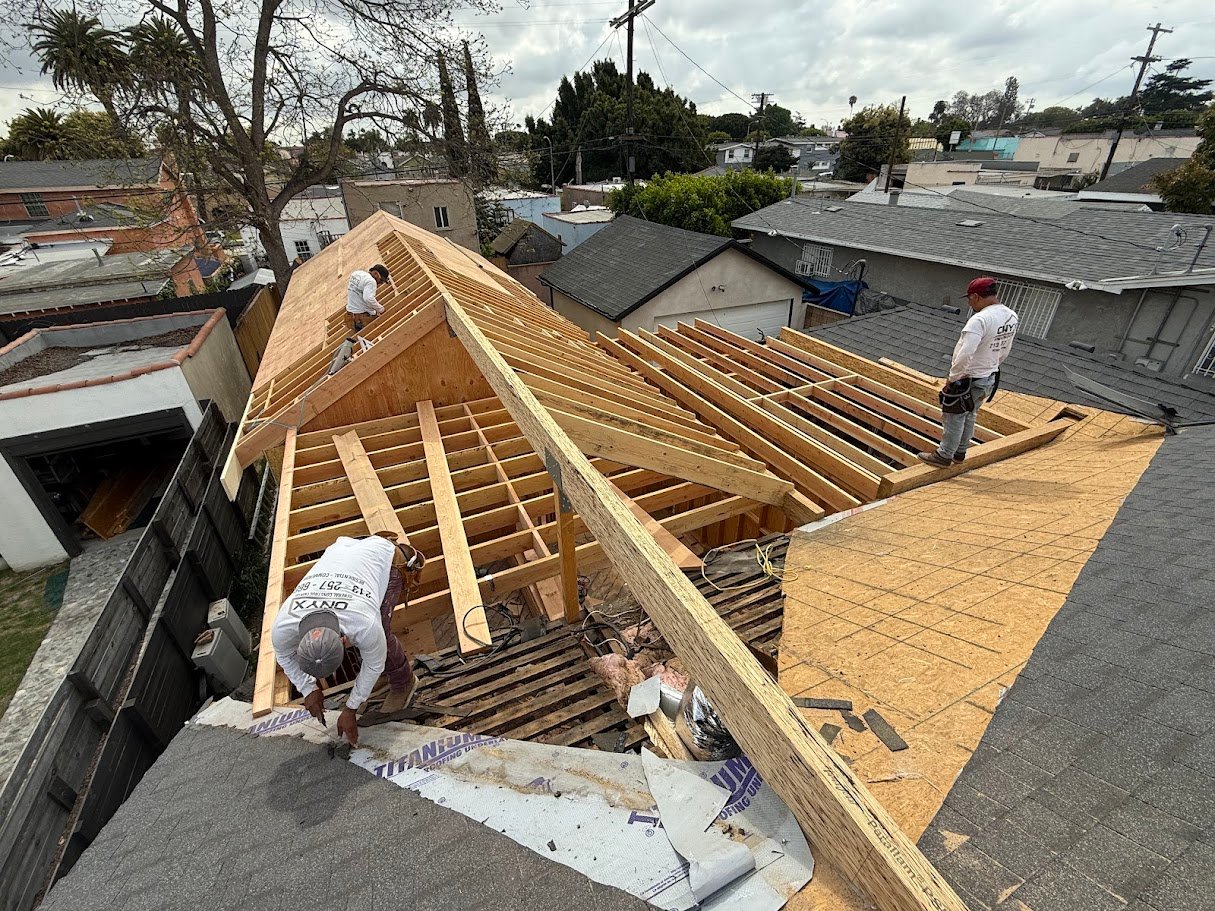
A structural engineer is responsible for ensuring that what gets built won't move, settle, or fail under the loads it will experience. In Los Angeles, where seismic risk is significant, this work is not a formality — it is the difference between a building that performs well in an earthquake and one that doesn't.
Structural engineers design the foundations, framing systems, shear walls, and connections that give a building its integrity. They work from the architect's drawings and translate the design intent into specifications that can be reviewed by LADBS and executed by the contractor.
For any project involving structural changes — removing walls, adding square footage, building an ADU, or modifying the foundation — a structural engineer is required. Their calculations are submitted as part of the permit package and are reviewed by the city before approval is granted.
Compliance and approvals
Both architects and engineers are responsible for ensuring that their designs comply with the California Building Code, local zoning ordinances, and LADBS requirements. Their stamp on the drawings is what allows the permit process to move forward.
Long-term cost savings
Well-designed projects cost less to build and less to operate. An architect who understands passive solar orientation, material durability, and efficient floor plans can meaningfully reduce energy costs and maintenance over the life of the home.
Fewer surprises in the field
Thorough construction documents reduce ambiguity. When the contractor has a complete, coordinated set of drawings, there are fewer questions, fewer gaps, and fewer change orders. That clarity has real dollar value over the course of a project.
Financing options for Los Angeles home improvement projects
How you fund the project affects the project itself — the timeline, the decisions you can make, and the pressure you're under during construction. Understanding your options before you need the money gives you leverage.

Equity-based financing
For homeowners who have built equity in their Los Angeles property, equity-based financing typically offers the lowest interest rates and the most favorable terms. There are three main approaches, each with different mechanics and trade-offs.
A home equity loan provides a lump sum borrowed against the equity in your home, repaid at a fixed rate over a set term. Predictable payments, but you receive all the funds at once regardless of when you need them during construction. A HELOC is a revolving credit line — typically up to 85% of your home's value minus the outstanding mortgage balance — where you draw funds as needed and pay interest only on what you've used. A cash-out refinance replaces your existing mortgage with a larger one, with the difference paid to you in cash. It works best when current rates are close to or below your existing rate.
Non-equity financing options
Not every homeowner has sufficient equity, or wants to leverage their home to fund a renovation. Non-equity options provide alternatives, though typically at higher interest rates.
Personal loans are unsecured, faster to obtain, and require no collateral — but interest rates are higher and loan amounts are typically lower. Best suited for smaller, well-defined projects. Construction loans are short-term loans specifically designed to fund construction, with draws released at project milestones rather than as a lump sum. They typically convert to a permanent mortgage at project completion and require detailed plans, permits, and contractor documentation to qualify. Credit cards and revolving credit are viable for smaller expenses and short-term bridging — particularly when introductory offers provide a 0% period — but are not appropriate as a primary funding source for significant construction projects.
Selecting a contractor and managing the build
Once permits are approved and financing is in place, the focus shifts to who will build the project and how the construction process will be coordinated. Both decisions matter more than most homeowners anticipate.

From LADBS approval to contractor selection
Once your building plans have been approved by LADBS, the permit is active and construction can begin — but only after a contractor has been selected and a contract has been signed that reflects the approved scope.
Get bids from at least three contractors, and make sure each bid is based on the same set of permitted drawings. Bids that come in significantly lower than others should prompt questions, not celebration — they often reflect assumptions, exclusions, or a mismatch between the scope and what the contractor is actually pricing.
Evaluate contractors on reputation, experience with projects similar to yours, and the quality of their communication during the bidding process. How a contractor handles questions and responds to requests during bidding is a reliable indicator of how they'll handle the project itself.
Verify license and insurance
Confirm the CSLB license is active and appropriate for the work. Request certificates of general liability and workers' compensation insurance before signing anything.
Compare bids carefully
Apples-to-apples comparison requires that every bidder is working from the same documents. Ask each contractor to itemize their bid so you can see where the numbers differ and why.
Plan material deliveries
Coordinate delivery timing with the construction schedule. Materials that arrive too early create storage and security problems. Materials that arrive late stop work. Sequence deliveries to each phase.
Manage the site actively
Regular site visits, scheduled progress reviews, and clear communication between homeowner, contractor, and architect are what keep a project on track. Passive ownership during construction is how problems compound before they're caught.
Jobsite conditions and logistics in Los Angeles
Construction in Los Angeles — particularly in dense neighborhoods, hillside lots, or properties with limited street access — requires specific logistical planning that affects both cost and schedule. Access for equipment and delivery trucks, on-site material storage, dust and noise mitigation, and neighbor coordination are all part of the job.
Work through these constraints with your contractor before construction begins, not after. A contractor who has built extensively across Los Angeles will have dealt with these conditions before — on hillside lots in Los Feliz, narrow streets in Venice, or tight parcels in West Hollywood — and will have practical solutions. One who hasn't may discover them as problems mid-project.
Ready to plan your project?
Onyx works with homeowners across Los Angeles from early planning through final construction. Bring what you have — an address, a rough scope, a question — and we'll help you find the right starting point.