Building an ADU in West Hollywood, with the WeHo process in mind
West Hollywood has its own Building and Safety division, its own plan check, and its own local rules layered on top of California's ADU law. Owners who treat WeHo like a smaller version of LA usually discover the differences in the middle of plan check — not a good time. This guide walks through how to plan an ADU here cleanly, from the first records pull to the final inspection.
Why building an ADU in West Hollywood takes a specific approach
West Hollywood is small, dense, and unusually invested in preservation, rent protection, and design quality. Most properties are built close to their lot lines, and a meaningful share of the housing stock is older multi-family. Adding an ADU here means navigating not only state ADU law but WeHo's own standards, historic considerations, and strong tenant protections. The planning phase is where the project is really made or lost.
Tenant and rent rules sit alongside zoning
On multi-family parcels, rent stabilization, relocation, and tenant notice rules can interact with an ADU project. Getting a clear read on those issues during planning is as important as the zoning analysis.
Lot constraints are tighter than they look
WeHo lots often have shared driveways, rear utility easements, and mature landscape. A survey, title, and utility locate should happen before a floor plan is chosen, not after.
What West Hollywood owners typically build
Most WeHo ADU projects fall into a few recognizable patterns, each with its own planning path.
Detached rear-yard ADUs on single-family parcels
The cleanest WeHo ADU scenarios. Setbacks, fire separation, and rear-yard coverage still have to be worked out, but these projects do not touch tenant rules and usually follow the shortest path through plan check.
ADUs on multi-family parcels and garage conversions
Converting a detached garage, adding a unit above a garage, or inserting a new unit on a multi-family lot. These projects need more planning around existing tenants, utility capacity, and parking replacement where it still applies.
Step-by-step: how a West Hollywood ADU project actually unfolds
This is the sequence owners should expect. Each step uses the correct WeHo-specific department or portal; assuming the City of LA process will work here almost always creates rework.
Land survey by a California-licensed surveyor
Start with a current boundary and topographic survey. Verify the surveyor through the California BPELSG license lookup. Every setback and fire-separation decision in WeHo depends on it.
Title and property records search
Pull a preliminary title report and any recorded easements or CC&Rs. Shared driveways and rear utility easements are common in WeHo and affect where an ADU can actually sit.
Zoning and parcel lookup via WeHo
Confirm zone, overlays, and any preservation conditions with West Hollywood Building & Safety. Cross-reference the California HCD ADU resource for the state baseline.
Prior permit history and document search
Pull the property's permit history through the WeHo Permits & Licenses Portal. Legacy unpermitted structures must be resolved before an ADU permit is issued.
Schematic design and plan development
Translate the survey, title, and zoning into schematic design, then into a full permit drawing set: site plan, floor plans, elevations, structural, Title 24 energy, and full MEP.
Pre-submittal meeting with WeHo Planning / Building & Safety
Use WeHo Permitting Services to request a pre-submittal for any scope that approaches setbacks, fire separation, or historic review.
Permit application and plan check via WeHo's portal
Submit through the WeHo Permits & Licenses Portal. Plan check is handled by WeHo Plan Check Services. Respond to corrections completely to avoid extra cycles.
Permit issuance and sub-permits
Once plan check clears and fees are paid, the building permit issues. The contractor pulls WeHo-specific electrical, plumbing, and mechanical sub-permits so every trade has an inspection record.
Inspections during construction
Expect inspections for foundation, framing, rough MEP, insulation, drywall, and trade sign-offs. WeHo inspectors coordinate their own schedule — plan for a dedicated project-side point of contact.
Final inspection and Certificate of Occupancy
Once all trades pass final and Title 24 verification clears, WeHo issues final sign-off. A Certificate of Occupancy for the new dwelling unit closes the record for rental and resale purposes.
What makes a West Hollywood ADU feel like it belongs
The strongest WeHo ADUs fit the block as if they have always been there — restrained, proportional, carefully detailed.
Scale and proportion over statement architecture
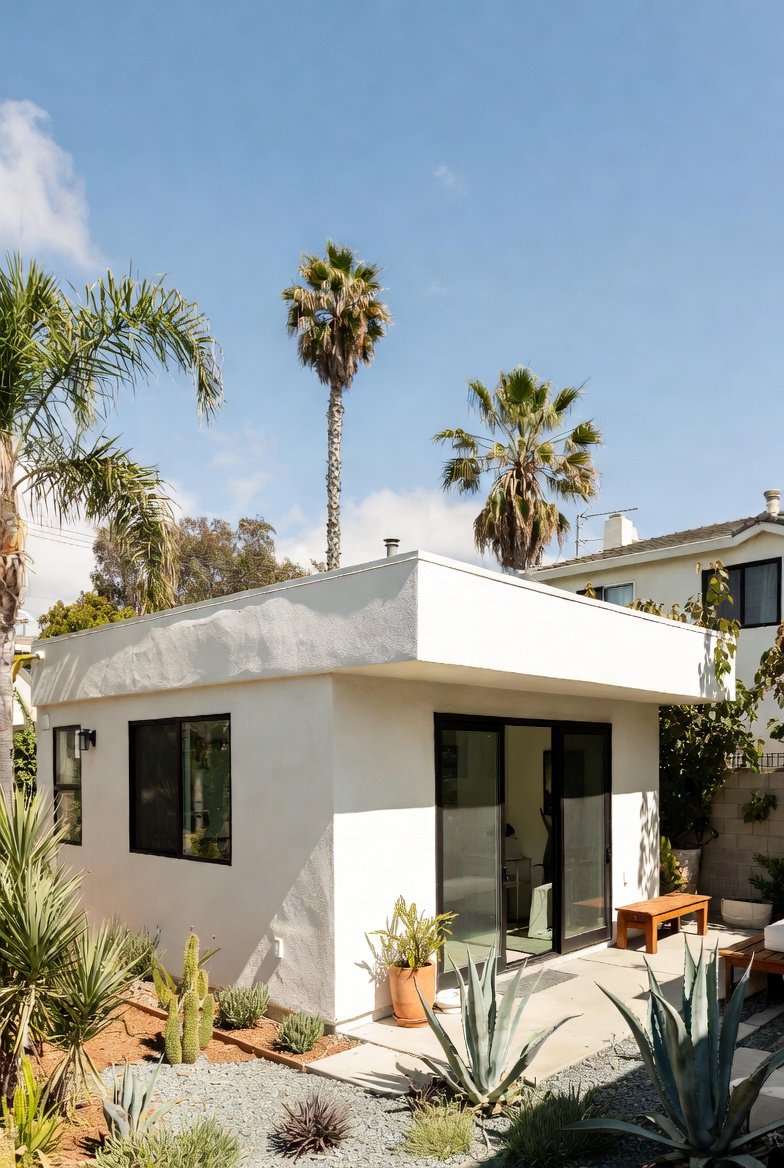
WeHo lots reward restraint. A smaller, carefully proportioned ADU will nearly always outperform a larger one that fights the main house or the block. Roof geometry and window rhythm should echo the primary structure.
Treat the space between buildings as its own room
The yard between the main house and the ADU becomes an important outdoor space. Paving, planting, and lighting planned during design give the property a much stronger finished read than a generic path cut through grass.
Jurisdiction resources: West Hollywood & California HCD
For the full step-by-step sequence, start with the West Hollywood construction planning-process guide. West Hollywood is its own jurisdiction. Use WeHo Building & Safety resources, not City of LA, for any ADU inside WeHo city limits. Pair with California HCD guidance for the state law baseline.
West Hollywood Building & Safety
Start here for permit, plan check, and portal submittal for WeHo ADU projects.
California HCD — statewide ADU rules
Use HCD's ADU resource page to understand the state law baseline on unit size, setbacks, and parking waivers.
Common mistakes West Hollywood owners make building an ADU
Most of the painful WeHo ADU stories come from assuming the process will work like Los Angeles. It does not.
Filing to the wrong jurisdiction
Trying to file a WeHo project on ePlanLA or treating LADBS as the reviewing authority is a direct path to rework. WeHo Building & Safety is the correct department for every step inside city limits.
Underestimating tenant and rent rules
On multi-family properties especially, ADU projects can intersect with rent stabilization and tenant notice rules. Ignoring those conversations during planning is how projects stall mid-construction.
Frequently asked questions
The questions West Hollywood owners ask most often before committing to an ADU scope.
Often yes. Most single-family and multi-family parcels qualify, subject to local setbacks and plan check. Confirm with WeHo Building & Safety first.
No. WeHo has its own Building & Safety division and its own permits portal. Use the WeHo system for every step.
State ADU law generally waives parking on qualifying parcels, but WeHo layers its own rules. Verify the waiver applies to your parcel.
They can, especially on multi-family parcels. Talk to the city and a qualified attorney during planning.
State law sets tight review deadlines. A complete package through the WeHo permits portal tends to move much faster than a partial one.